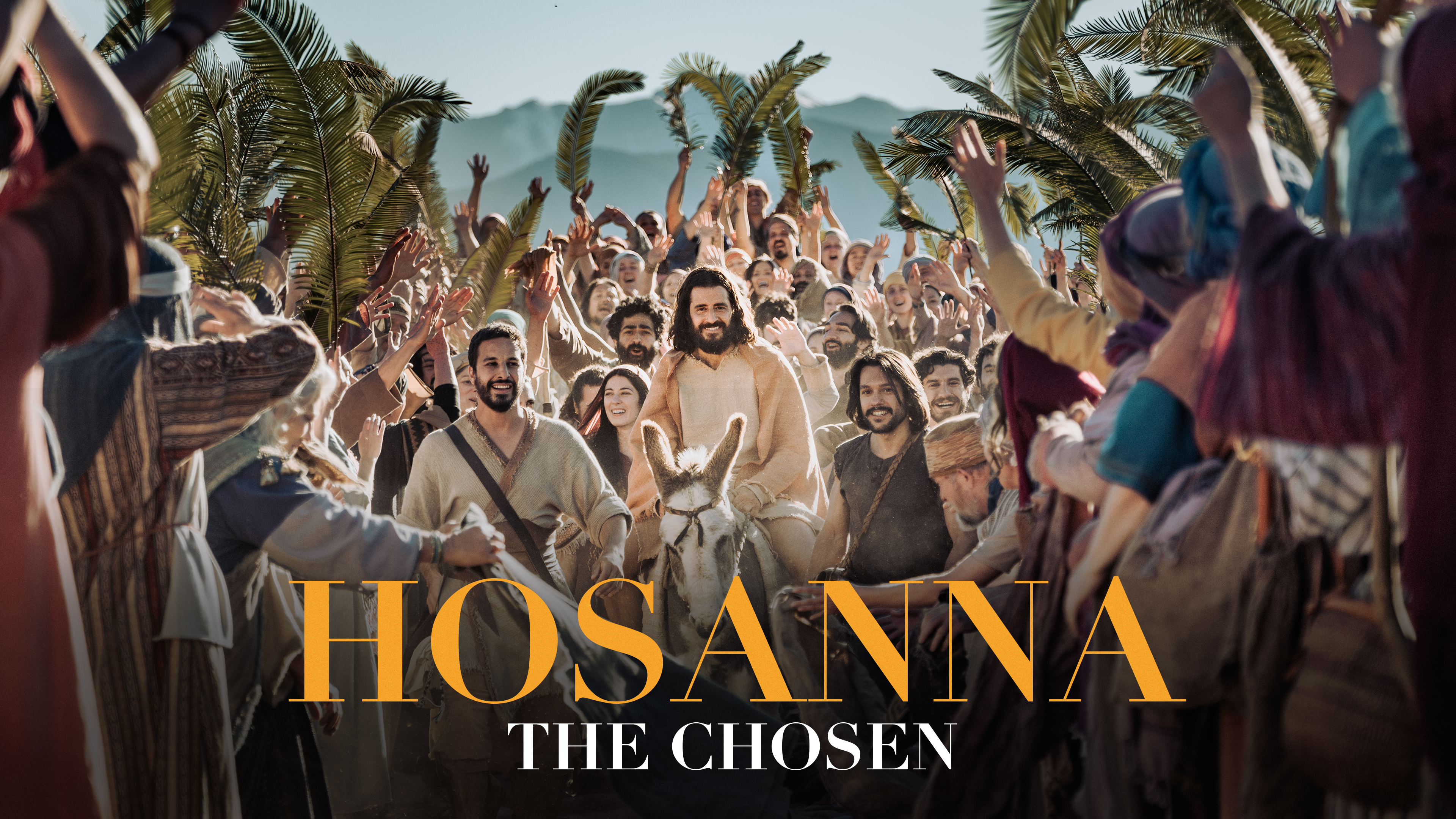
Hosanna: Palm Sunday Sermon Map
Dominant Thought
Do not be afraid; the king has come to us.
Key Passages
John 12:12-19
Assorted Old Testament passages
Assorted New Testament passages
Introduction
Suggested Approach for the Introduction
We would suggest starting your sermon by simply showing the clip from The Chosen that’s provided with this sermon map — a clip that depicts a short moment from the Upper Room and then backs up to show the events of Palm Sunday.
Transition to Section One
In the first half of Section One of this sermon, we’re inviting you to explore Israel’s disappointment and doubt concerning the possibility of a king who will save her, so saying something along these lines — which introduces the critical passage of 1 Samuel 8 (starting in verse 5) — is an effective way to transition from the clip to the first section of the sermon: “Hundreds and hundreds of years before everything you just watched unfolded, the people of God gathered around a priest named Samuel, and this is what they said: ‘You are old, and your sons do not follow your ways; now appoint a king to lead us, such as all the other nations have.’”
Section One
Suggested Areas of Study for Crafting Section One
1 Samuel 8
The kings of Israel — from the initial trio of Saul, David, and Solomon, through
the kings of the southern and northern kingdoms — with careful attention paid to
their shortcomings
Suggested Teaching Point for Section One
Every king that’s come along has always left us longing.
Suggested Approach for Section One
For the bulk of this section of the sermon, we’d suggest you either (1) read as much of 1 Samuel 8 as you like, offering commentary along the way that’s born out of your study, or (2) tell the story of 1 Samuel 8 in your own words (with commentary). In your reading or retelling, the first thing to establish for your listeners is that Israel rejected God as king and instead desired a king that looked like those of other nations. The second thing to establish is why she did: she wanted the peace that comes with the warring success and intimidating presence of a strong-man king.
At this point, step further into the story of 1 Samuel 8 to show your listeners God’s incisive word to Samuel (and then to the people through Samuel): that the people will only be disappointed in the kings that will come their way. And then show them just how right God was in this prophetic word, drawing from your survey of Israel’s kings to do so. But first, it would be wise to acknowledge the kings did bring along stretches of peace and prosperity for Israel through military aggression, suppression, and protection. To whatever degree you wish to highlight this, have at it. But emphasize that any peace and prosperity came only in stretches, allowing you to then lay out the broader list of how each and every king that came along failed the people of Israel. Show your listeners how warring success and intimidating presence only ever managed to inspire more war, sometimes even between fellow Jews, and all of this managed to bring along more loss.
As your survey comes to a close, be sure to say something along these lines — “every king that came along for Israel left her disappointed” — and then it’s time to go even deeper in exploring the disappointment Israel had in her kings. Help your listeners understand that even in times of peace and prosperity — even in the times where her enemies had been subdued and battled were stilled — Israel knew that every king that ever came along was still going to leave her disappointed, because they were ever and always going to leave her with ongoing death threats (that is, enemies would always be lying in wait) and worst yet, they were always going to leave her spiritually dead (because there was still the great Enemy of Death itself). It didn’t matter what the king did by way of aggression, suppression, and protection; the neighbors of Israel remained her enemy and so did Death.
All of the above allows you to state a variation of the suggested teaching point for Section One: “Every king that came along for Israel always left them longing.” And once you’ve stated this truth for Israel, you can shift the focus to your listeners by stating the suggested teaching point as it stands in contemporary, personal terms: every king that’s come along has always left us longing.
To close Section One, you’ll want to explore our own clamoring for strong-man kings and the disappointment each king has brought our way. Given that we don’t operate in a world of kings and queens, this might seem like a tricky needle to thread. It isn’t. Even today we seek (and place far too much hope in) any number of figures of authority to bring us peace and prosperity via aggression, suppression, and protection. And with regard to the more spiritual, even today we see (and place far too much hope in) any number of figures of authority to bring us salvation — even religious leaders, with their disciplines, teachings, and programming. The examples you use — and in particular, just how far you go with this politically — is up to you as the pastor of your listeners. But pastorally and prophetically, you’ll want to confront the clamoring for kings, finding your way toward repeating the suggested teaching point for this section: every king that’s come along has always left us longing. (Note: Because the two sermons mirror each other a bit in overall sermonic journey. you could do a bit of a callback here to the previous sermon: “Just as the bread of this world leaves our soul’s roaring, the kings of this world leave us longing.”)
Transition to Section Two
Right after you say, “Every king that’s come along has always left us longing,” we’d suggest you pause for just a moment before saying the following to transition right into Section Two: “Except one.”
Section Two
Suggested Areas of Study for Crafting Section Two
John 12:12-19
Deuteronomy 17:16
1 Kings 1
The significance of the imagery of a donkey as it pertains to kingship
The significance of the palm branches
The significance of the cries of the people (e.g. “Hosanna”)
The Book of Zechariah (general study and survey)
Israel’s expectations for the coming king/the coming Messiah
John 12:20-23
Suggested Teaching Point for Section Two
Jesus, King of Kings and Lord of Lords, wins our deepest battles.
Suggested Approach for Section Two
Remember our suggested line in the transition from Section One to this second section: “Every king that’s come along has always left us longing — except one.” Just after you’ve spoken that. line, it’s time to pull your listeners back to the scene that played out before them at the very start of the sermon. You can do so by saying the following: “At the very start of the sermon, we watched the triumphal entry of Jesus in a clip from the TV series The Chosen; let’s listen to it this time around. Here’s John 12:12-19...” As you read the passage, place a bit of emphasis on verse 15: “Do not be afraid, Daughter Zion; see, your king is coming, seated on a donkey’s colt.” And once the passage has been read, we’d suggest you go on and repeat verse 15 for even further emphasis, before saying something along these lines: “I don’t know if on that Sunday long ago anyone in the crowd actually spoke those words from the Old Testament. But if someone did, they really didn’t have to. The crowds would have already known a king was in their midst.” And with that said, you need to prove your point by making good use of your study on the significance of Jesus being atop a donkey (see Deuteronomy 17:16 and 1 Kings 1). It’s not enough, though, for you to tell your listeners that the people knew a king was in their midst. The people knew the king was in their midst. Be sure to make this point — and to then go about proving it. Show from your study of what the people cried out (“Hosanna!”) that they clearly knew Jesus was unlike any king before him. (And though it’s not mentioned in John’s account, you might even want to mention how other gospel accounts of the triumphal entry speak of people declaring Jesus as the “Son of David,” a messianic claim). Once you’ve shown that the people clearly know Jesus is the king, move along into explaining how they knew this was the case. Here is where you need to weave in what you learned from your time in Zechariah. Explain to your listeners how the people gathered together that day in Jerusalem would have been familiar with the Old Testament prophecy of Zechariah. (The Chosen captures this well in the scene you showed, so feel free to point back to it!) Pointing to select passages, explain that they would have known that the first eight chapters of Zechariah speak to the devastation of Israel as a people and a nation at the hands of her enemies. Pointing to select passages, explain that the people gathered that day in Jerusalem would have also been familiar with the promises of God, spoken through Zechariah, to bring along a king who would conquer all nations once for all to save and restore Israel as nation of nations. And turning to the most critical passage in Zechariah — 9:9 — explain how the people gathered in Jerusalem that day would have been familiar with the prophetic word that Israel would know when the king had finally arrived because he would make his way toward them in a manner that echoed the past actions of King David: on a donkey. And having pointed out all of these things to your listeners, circle them back to what you said earlier: the people gathered that day in Jerusalem would have clearly known Jesus was the king — the long-promised messianic king who would save and restore Israel. But now that they were “crowning” Jesus their messiah-king, what did the people expect from him and of him? Here is where you need to draw from your study of the expectations Israel had for (and of) the Messiah — and really, your study of 1 Samuel 8, too. As the people waved the palm fronds and cried out, they had in mind that Jesus would bring them peace and prosperity, and that he would do so through warring success and the intimidating presence of a strong-man king. Jesus would surely rage against the nations, taking up the mantle of a warrior who would crush all of Israel’s oppressors and potential oppressors — beginning with Rome, and moving outward and to the ends of the earth. (In fact, here is where you can sneak in the significance of the people waving palm branches in the air. Your study has probably pointed you in the direction of the Maccabean revolt, which further indicates the people seem to anticipate that kind of militaristic might on the part of Jesus.) Along the way, be sure to acknowledge that these expectations on Israel’s part were quite understandable for any number of reasons:
She was tired of being oppressed.
This was how the broken and cruel world worked — people warred against each other.
Her history was filled with stories of God warring against the nations.
And perhaps most notably, point out some of the passages in Zechariah that do seem to
speak to military might on the part of Israel’s messiah-king.
Once you’ve offered this short stretch of teaching on the people’s expectations for and of Jesus, you might want to say something like, “It’s perfectly understandable why Israel believed God’s messiah-king would rage against and subdue the nations — and then establish Israel as nation of nations, ushering in prosperity like never before. And so it’s perfectly understandable why an oppressed people were excited that Sunday long ago.” And once you’ve said that, you’ll want to pause for a moment before saying this: “And so it’s perfectly understandable why the people were terribly disappointed in the days to come, and especially in the events of Good Friday.”
At this point, then, show your listeners all the many ways the people would have been crushed by Jesus’s actions during Holy Week, and especially on Good Friday. They would have been crushed by his admonishment of the ways of the Temple; crushed by his copping to paying Roman taxes; crushed by his teachings that seem to put Israel on the defensive and speak of her judgment alongside the other nations; crushed by his unwillingness to band together with the religious authorities; crushed by his meek and mild presence before Roman authorities; crushed by his humiliating crucifixion; crushed by his death and burial. Show your listeners just how crushed the people would have been and how that’s (at least in part) why they turned against Jesus, when all was said and done. And then maybe say something like this: “On the Saturday after that Palm Sunday — on that Saturday after the dark and devastating events of Friday — the people would have been crushed. They would have been crushed and afraid. Afraid that the king will never come — and with his never coming, the fact that victory over her enemies will never come.” And then pause before you add this critical addition: “But on that Saturday, they shouldn’t have been afraid. They should have been rejoicing as much as they’d been on that Sunday before. In fact, they should have been rejoicing on an even greater and deeper level than that Sunday before. Because Jesus was accomplishing far more as king than they had even wanted.”
At this point, you’re entering into the most critical juncture of the sermon, where you establish why Jesus is a king against whom all other kings pale in comparison. Here is where you lay out for your listeners how Jesus is the only king who thinks beyond fleeting forms of peace and prosperity and the self-defeating means to achieve both and addresses the deepest needs of the world, thus ushering in the deep flourishing that all other kings have failed to bring about.
Employing whatever you see fit — gospel narratives, key teachings from Jesus in the Sermon on the Mount, further teachings from New Testament authors — alongside key elements from your study of the central passage for the sermon (John 12:12-19), show in short-but-cogent fashion how Jesus does not leave Israel as a pitiful welcome mat for her enemies, even as he does embrace military aggression, suppression, and protection. Instead, his laying down his life shatters the cycle of military aggression, suppression, and protection, showing a way forward to peace. But more so, he is the way to peace because it is only under “one Lord, one faith, one baptism; one God and Father of all” that battles can be stilled. Jesus secures an unfolding victory through deep love. If time allows, it would make for a powerful moment to do two things:
Maybe swing back to Zechariah, showing your listeners that just after the reference in 9:9
to a coming king atop a donkey, Zechariah clearly lays out this deeper work of kingly
victory through kingly love. Via key passages from Zechariah 10-14, show your listeners
the promises of forgiveness, of healing and new life, and of ever-increasing unity with
global neighbors.
After you’ve shared a bit from Zechariah, you could then say, “In fact, kingly victory “over
enemies” through kingly love is already happening on Palm Sunday itself!” In John’s gospel,
just after the events of Palm Sunday, “some Greeks” approach the disciples about the
possibility of spending time with Jesus. It’s a subtle nod to the world drawing near this new
king; it’s a subtle nod to the victorious ways of Christ-like love.
At this point, then, you need to acknowledge that you’ve only spoken to victory over enemies; you have yet to address the Enemy (Death). And you need to go a step further and acknowledge that “even if Jesus as king were able to turn enemies to brothers and sisters, there would still be reason to be disappointed — and really, quite afraid. Because the Enemy still needs to be taken care of. Death needs to be dealt with.” And though this is indeed rushing a bit ahead to Easter Sunday, even here on Palm Sunday, off you need to go to speak to the great conquering of death through Jesus’s resurrection. If you like, you could explore some of what Jesus says in the verses that follow the events of Palm Sunday — John 12:23ff. There are images in there to play with about death and life and eternity. If you think you can do so in a way that doesn’t bog down the proceedings of the sermon, now might be an opportunity to speak of how you aren’t just talking about death here; you’re talking about the dangers of Second Death, as Scripture puts it. Physical death in this broken world will always come, but in Jesus, the reality of a Second Death due to our rejection of God, has been overcome — defeated — and resurrection (new life, second life) is attainable. This is the victory of the King!
Having journeyed through the material above, point out to your listeners that when the people cried “Hosanna!” on that first Palm Sunday — when they cried out, “Save us! Now!” — they had no idea just how much Jesus was going to answer their pleadings. And it’s here that you can say something along these lines — “Our passage from John tells us that on the other side of Jesus’s death, burial, and resurrection, everyone, including even his disciples, could finally see that there was no reason to be afraid, for Jesus was the king and even more of a king than ever imagined or expected” — before you pause and say this, too: “Do we see? All these years later. After hundreds of Palm Sundays. Knowing Jesus’s ministry, his death, his burial, his resurrection: do we see that Jesus is king? The king? The only king who leaves us forgiven, healed and resurrected, and united? This is the message of Palm Sunday to Israel of yesterday and to us today: Jesus, the King of Kings and Lord of Lords, wins our deepest battles.
Transition to Section Three
To transition into this final section of the sermon, you need only say something along these lines: “I do hope we see that the king has come to us in Jesus. That there is no king like him, because in him there is no reason to fear sin or sickness — or death or division — any longer. But to go alongside my hope that we see our king has come to us is a hope that we keep our eyes on this truth. That we cultivate and maintain this belief.” And then, drop the next and final suggested teaching point: If the king has come, our longing for other kings who will only leave us longing must end.
Section Three
Suggested Teaching Point for Section Three
If the King of Kings and Lord of Lords has come, our longing for other kings and lords who will only leave us longing must end.
Suggested Approach for Establishing Teaching Point
You’ll notice that this final section of the sermon map is quite short when compared to the other sections. That’s because this section is devoted to congregational application, and we trust your pastoral giftedness and insight. What you’ll first want to do is establish just how fickle we can be in our allegiance to Jesus as the king even when we’ve clearly seen how superior a king he is.
We are ever-enamored with other figures of authority who come along. We are ever-enamored with ourselves as a figure of authority! You might even want to point out that we are as fickle as Israel of old. After all, if we turn just a few pages further in John’s gospel — from the start of Holy Week on Palm Sunday to the events of Good Friday — we see the crowds clamor for
Barabbas, a figure of authority, in that he’s an insurrectionist. And on a deeper and darker note, we see the crowds give away Jesus as king. Maybe explain to your listeners why Palm Sunday is such a critical day on the church’s calendar: it puts our eyes back on the unparalleled kingship of Jesus, forcing us to reckon with both who he is and who we have instead chased after. And maybe here you restate that suggested teaching point: If the king has come, our longing for other kings who will only leave us longing must end. And then from there, it’s time to think aloud with them about ways they can keep their eyes — and hearts and minds — on Jesus as the king, that they might hold fast to an allegiance to him and him alone. As another nod to the previous week’s sermon, you could add that “the same ways we identify to keep our eyes — and hearts and minds — on Jesus as the king, are ways we can keep our eyes — and hearts and minds — on Jesus as Bread.”
To reiterate: we trust your pastoral giftedness and insight with regard to what you want to share by way of application and challenge. Now might be the time to revisit the power of certain disciplines that have long aided the church in such a challenge. It might prove helpful to speak particularly to prayer and encourage your listeners to make it a regular practice — even outside of Palm Sunday — to pray on the daily the simple prayer of, “Hosanna!” That simple daily cry for salvation puts Jesus in his rightful place as the king, while putting us in our place as those who need him and him alone. While you would need to do so in a manner that is tender — but no less potent — perhaps you should challenge certain political proclivities. You could point your listeners in the direction of resources that have helped you keep your own eyes on Jesus as the one true king. Or maybe this sermon can be an opportunity to launch small groups or Sunday
School classes in the latter half of April and on into May that will explore a resource that speaks to the kingship, authority, or even beauty of who Jesus was, is, and always will be.
Not to sound like a broken record, but — we trust you with the direction(s) you go in this time of application.
But we do have one suggestion in particular...
Transition to Conclusion
As you wrap up your time of application, we would encourage you to say something along these lines: “When all is said and done, perhaps the greatest and most impactful way to hold allegiance to Jesus as the king is to create space for deep worship of him as king. It’s hard to long for other kings when we’ve busied ourselves with elevating and praising the one who truly is king.” And with that, it’s time for the Conclusion.
Conclusion
To bring the sermon to a close — and to set the stage for a time of congregational worship through song — it would be fitting to pull your listeners back to the central passage one more time. You probably picked up on this in your study of the text, but in John’s account of Palm Sunday, when he quotes Zechariah 9:9, he changes it a bit. Zechariah does not say, “Do not be afraid...your king come to us;” he actually says, “Rejoice!” The reason for John’s tweaking is simple: we often have to make our way through (and beyond) fear if we’re ever to rejoice. Tell your listeners that “we now stand on the other side of Jesus offering forgiveness, resurrection, and peace” — that “there is none to fear,” and “it is time to rejoice, and our rejoicing will help us in our remembering that Jesus is king.” And then tell them “rejoicing is what we’ll now do, as we stand and as we sing...”